











Essential Guide to Commercial Photography | Fuze Reps USA
Key Highlights
- Commercial photography production is a full-service process that plans, manages, and executes a photo shoot from concept to the final product.
- The process ensures your commercial images align with your brand identity and speak directly to your target audience.
- Production covers everything, including creative planning, artist selection, budgeting, shoot coordination, and post-production.
- Various types exist, from product photography and lifestyle photography to fashion and food, each serving a unique business goal.
- Working with a production partner streamlines commercial work, reduces risk, and ensures consistent quality for brand awareness.
Introduction
In today's visually driven market, high-quality images are essential for your business. But what does it take to create visuals that truly capture your brand and drive results?
Commercial photography production is the answer. It’s a comprehensive process designed to translate your business goals into powerful images.
For brands and agencies, understanding this process is key to meeting client expectations and creating a cohesive brand identity that connects with commercial clients and achieves measurable success.
Understanding Commercial Photography Production
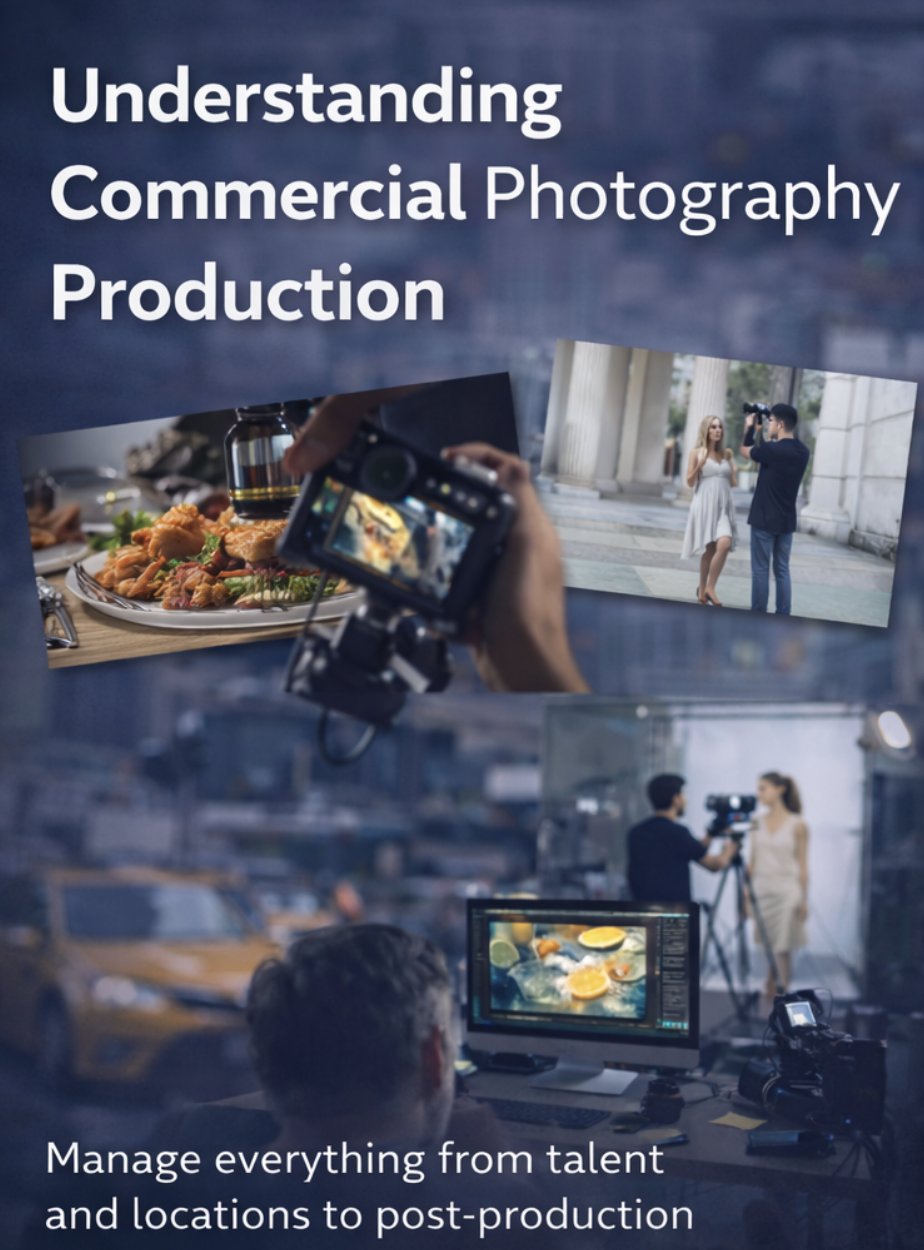
Commercial photography production is the strategic planning and execution of a photoshoot for commercial purposes.
It goes beyond simply taking pictures; it’s about managing every detail to bring a creative vision to life in a way that supports business objectives.
For commercial clients, this means having a partner who can handle everything from budgeting and scheduling to post-production and final delivery.
This end-to-end management ensures that your brand presence is strong, professional, and consistent across all marketing channels. Let's explore what makes this field unique and what it aims to achieve.
Defining Commercial Photography for Brands and Agencies
At its core, commercial photography is any image created to sell or promote a product, service, or organization. For brands and agencies, this is the visual engine that powers marketing, advertising, and sales.
The primary goal is to support a business in making more money, whether through direct sales or by building brand recognition.
These images are intended for commercial use across a wide range of platforms, including websites, social media, print ads, billboards, and product packaging.
The creative direction is always guided by the need to communicate a specific message to a defined target audience.
It’s about creating visuals that not only look great but also persuade and convert.
Rather than just capturing a moment, this type of photography is a calculated effort.
It involves conceptualizing a shoot that aligns with a brand's strategy, resonates with its customers, and ultimately drives business growth.
How Commercial Photography Differs from Editorial and Consumer Photography
It’s easy to group all photography together, but commercial photography has a distinct purpose that sets it apart.
Unlike consumer photography, which is for personal use like family portraits or wedding albums, commercial images are created for business.
The end use of the images is what defines this type of photography.
The distinction from editorial photography is more subtle but equally important.
Editorial photography is used to accompany an article or story in a magazine or online publication, focusing on storytelling rather than direct selling.
Commercial photography, however, is explicitly for commercial purposes—its job is to advertise, promote, and drive customer engagement.
While a photographer’s portfolio images might showcase a variety of styles, the key difference lies in the objective.
If an image is created with the intent to help a business sell something, it falls firmly into the commercial category.
Key Goals of Commercial Photography Production
The ultimate aim of commercial photography production is to help a business succeed. Every decision, from the creative concept to the final edit, is tied to achieving specific business goals.
These visuals are a strategic tool in your marketing efforts, designed to deliver a tangible return on investment.
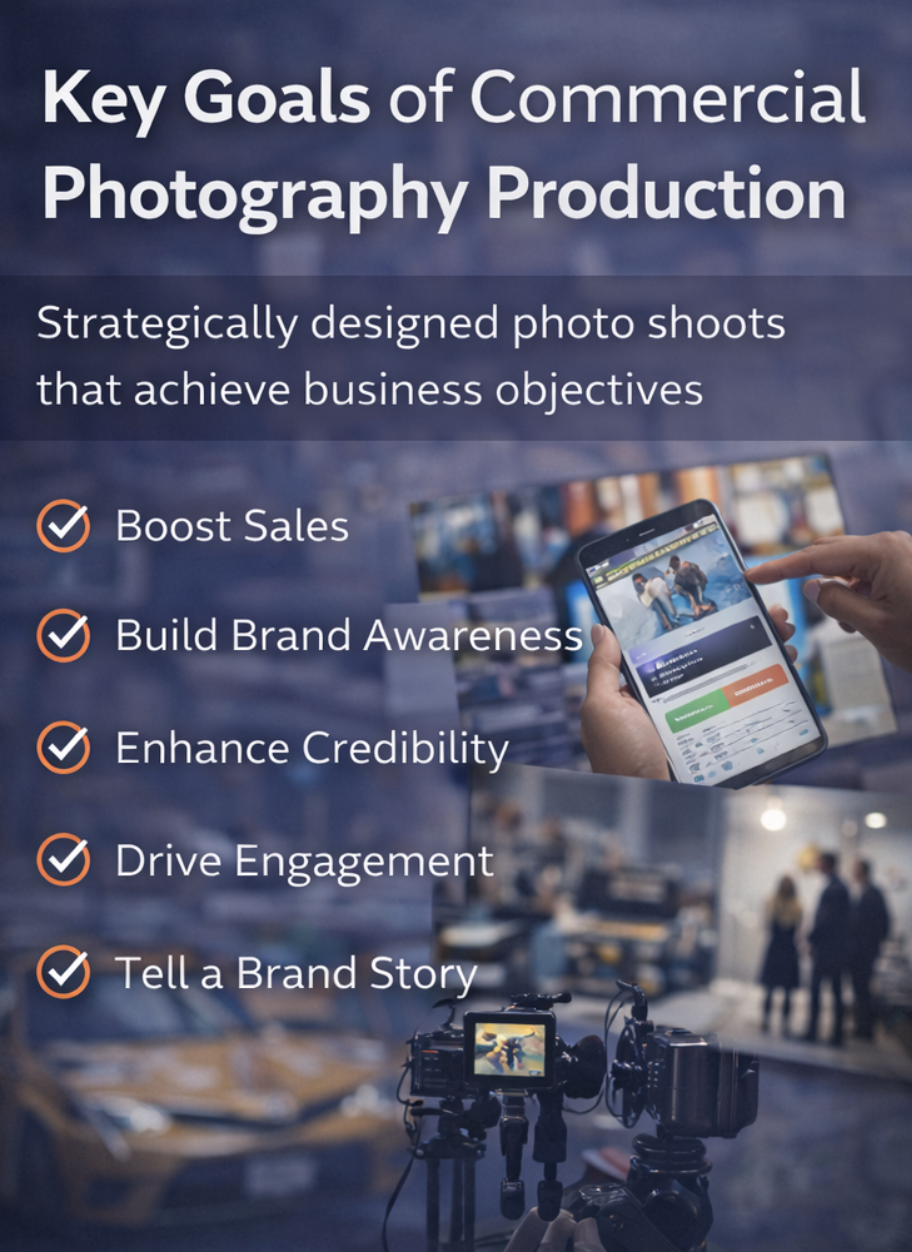
The commercial images created through this process are meant to do more than just look pretty on a social media feed. They are crafted to perform. The primary objectives of a commercial shoot typically include:
- Boosting sales and conversion rates
- Building brand awareness and recognition
- Enhancing brand credibility and trust
- Driving engagement on websites and social media
- Telling a compelling brand story
By focusing on these goals, commercial photography becomes an integral part of a company's growth strategy, helping it connect with audiences and stand out in a competitive landscape.
Types of Commercial Photography Production
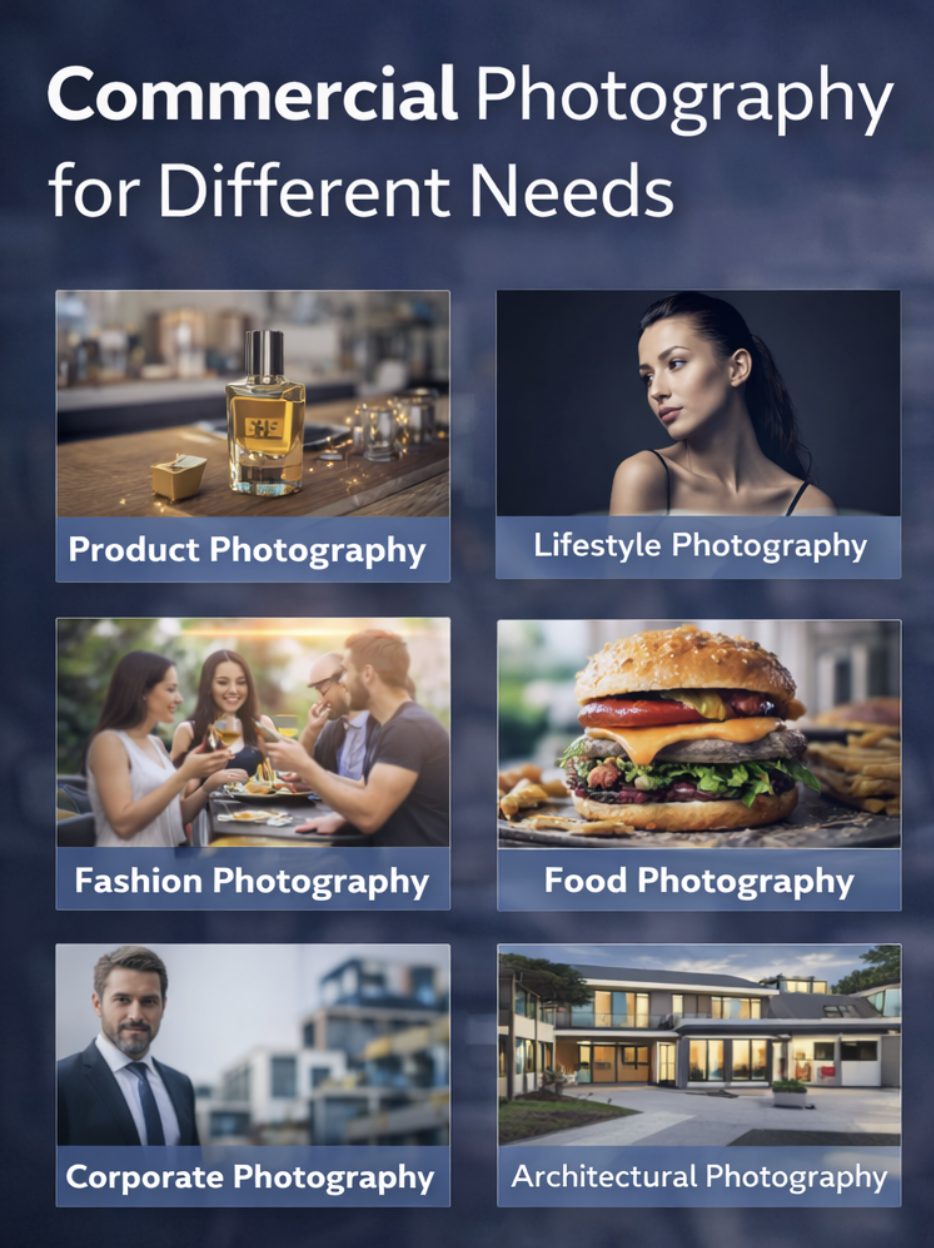
Commercial photography is a broad field with many specializations.
The different types of commercial photography each serve a unique purpose, but all share the common goal of promoting a product or service for commercial use.
Whether you need crisp images of a new product or relatable lifestyle shots, there’s a niche for it.
Understanding these various categories helps you identify what kind of commercial work your brand needs.
From product photography that drives e-commerce sales to lifestyle photography that builds an emotional connection, each type offers a powerful way to communicate with your audience.
Below are some of the most common specializations.
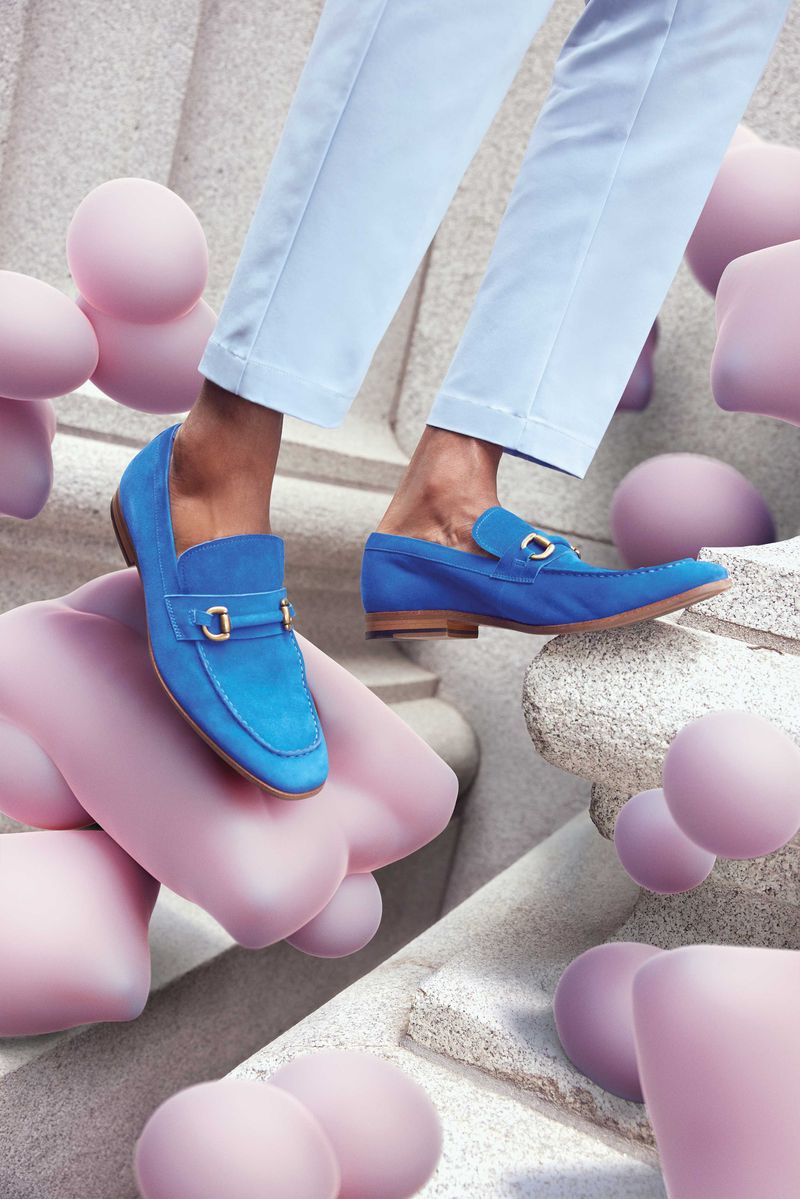
Product Photography for Retail and E-commerce
Product photography is essential for any business in the retail sector, especially for online stores.
These images are your digital storefront, giving customers the information they need to make a purchase.
The goal is to showcase your products in the best light possible, highlighting features, quality, and details.
creative production for brands
There are two main styles.
The first is the studio shot on a clean, neutral background, which is standard for e-commerce sites and catalogs.
This style helps the product stand out without distractions.
The second is a lifestyle shot, which shows the product in a real-world context, helping customers visualize how it fits into their lives.
Ultimately, high-quality product photography is crucial for improving conversion rates.
The best images not only look professional but also build trust and give shoppers the confidence to click "buy," making it a vital investment for any brand selling products online or in print.
Fashion and Apparel Photography
Fashion photography is all about creating a mood and telling a story that reflects a brand's identity.
This specialty focuses on clothing, accessories, and apparel, but its purpose goes far beyond simply showing the items.
It aims to create an emotional appeal and sell a lifestyle that the target audience aspires to.
These shoots are often complex, involving models who are comfortable in front of the camera, stylists, makeup artists, and carefully chosen locations.
The resulting images are used in everything from e-commerce product pages to high-concept advertising campaigns on billboards and in magazines.
The style can range from clean, studio-based shots for online catalogs to elaborate, on-location stories that capture the essence of a collection.
In every case, fashion photography is a powerful tool for building a distinct brand identity and connecting with consumers on an emotional level.
Food and Beverage Photography
Have you ever looked at a photo of a meal and felt your mouth water? That's the power of effective food photography.
This specialized field is dedicated to making food and drinks look as delicious and appealing as possible. It's a crucial tool for restaurants, food brands, cookbooks, and marketing agencies.
Creating these tempting images requires a unique set of skills. Photographers and food stylists work together to arrange the dish, find the best light, and capture textures and colors that make the food pop.
It's a meticulous process where every crumb and garnish is placed with intention.
After the shoot, post-production techniques like color correction are used to enhance the final images, ensuring they look vibrant and appetizing.
Whether for a menu, an advertisement, or a social media post, great food photography can significantly increase brand awareness and drive customers to take a bite.
Corporate, Headshot, and Team Photography
Putting a face to your brand is a powerful way to build trust and humanize your business.
Corporate photography, including professional headshots and team photos, helps achieve this by showcasing the people behind the company.
A polished and consistent headshot for each team member creates a unified, professional look across your website, LinkedIn profiles, and other corporate materials.
These are not your average snapshots. A professional headshot is carefully crafted to reflect both the individual's personality and the company's brand.
The goal is to present your team as approachable, credible, and expert in their field, which helps meet client expectations for professionalism.
Whether you're updating your "About Us" page or creating a professional online portfolio for your executives, high-quality corporate photography is a strategic asset.
It aligns your team's visual representation with your overall business goals, making a strong first impression on clients, partners, and potential hires.
Architectural and Real Estate Photography
Architectural and real estate photography is about capturing spaces in their best possible form.
This specialty is essential for architects, interior designers, property developers, and real estate agents who need to showcase buildings, homes, and commercial properties.
The goal is to highlight a property's design, features, and overall atmosphere.
This type of photography requires a keen eye for lines, composition, and lighting.
Photographers often work from a detailed shot list to ensure they capture every important angle, from wide shots of the exterior to detailed images of interior design elements. The right lighting is crucial for conveying a sense of space and ambiance.
The final product must be both beautiful and informative, helping potential buyers or clients visualize themselves in the space.
Whether selling a home or showcasing a design portfolio, professional real estate photography and architectural photography are indispensable for making a property look its absolute best.
Lifestyle and Branding Imagery
Lifestyle photography bridges the gap between a product and the consumer by showing it in a real-world, relatable context.
These lifestyle images are designed to evoke an emotion and help your audience see how your brand fits into their lives.
It's less about the product itself and more about the story and feeling associated with it.
This style of photography is a cornerstone of modern branding.
It captures the essence of your business and tells your story in a way that feels authentic and engaging.
For commercial clients, lifestyle photography is a powerful tool for building a connection with their target audience, moving beyond features and benefits to create a genuine emotional link.
A successful lifestyle shoot is guided by a strong creative vision that is deeply rooted in the brand's identity.
The result is a collection of images that can be used across websites, social media, and advertising to build a consistent and compelling brand narrative.
Industries That Rely on Commercial Photography Production
Nearly every industry can benefit from professional commercial photography.
From global corporations in a major city to local startups, high-quality visuals are a universal need for connecting with potential clients and customers.
Any business with a marketing department understands that how a brand is seen visually can make or break its success.
While some businesses may try to get by with makeshift solutions, industries that are serious about growth recognize the value of professional commercial work.
Let's look at some of the key sectors that regularly invest in commercial photography production to elevate their brand and drive results.
Retail and Consumer Brands
The retail and consumer brand sector is arguably one of the biggest users of commercial photography.
In a market saturated with choices, compelling visuals are what grab the attention of potential customers. Whether for e-commerce, print ads, or social media, images are the primary way these brands communicate the value and appeal of their products.
For online stores, professional photography is not just a nice-to-have; it's a necessity.
Customers can't touch or feel the product, so images must do all the work of conveying quality, size, and texture.
High-quality product shots, lifestyle images, and branding photos are directly linked to higher conversion rates and reduced returns.
Beyond e-commerce, these images fuel social media content, in-store displays, and advertising campaigns.
A consistent and attractive visual identity helps retail brands build a loyal following and stand out in a crowded marketplace.
Agencies and Creative Studios
Advertising agencies, marketing firms, and creative studios are the strategic minds behind many brands' visual identities.
They rely heavily on commercial video production to bring their campaigns and creative concepts to life for their clients.
These agencies act as a bridge, translating a brand's goals into a tangible creative vision.
An art director at an agency will often develop the concept for a photoshoot and then partner with a production team to execute it.
This collaboration ensures that the final images align perfectly with the campaign's objectives, whether the photos are for commercial use in a national ad or for a targeted digital campaign.
For these agencies, having a network of reliable photographers and production partners is crucial.
It allows them to deliver consistent, high-quality work for a diverse range of clients, ensuring every project is executed professionally and effectively.
Hospitality and Travel
In the hospitality and travel industry, photography is used to sell an experience.
Hotels, resorts, airlines, and tourism boards use images to transport potential customers to different destinations, long before they book a ticket.
The goal is to evoke a sense of wanderlust, relaxation, or adventure, inspiring viewers to make a reservation.
For a hotel, this means showcasing pristine rooms, inviting pools, and gourmet dining. For a travel company, it might involve capturing breathtaking landscapes or vibrant cultural scenes.
These images are used for commercial purposes across websites, booking platforms, brochures, and social media to attract and entice travelers.
Because the industry is all about aspiration, the quality of the photography has to be exceptional.
Professional images that capture the unique atmosphere of a location can make all the difference in a potential customer's decision-making process, making it a critical investment for any business in this space.
Technology and Startups
The technology sector, from established giants to nimble startups, increasingly relies on commercial photography to make complex products and services feel more human and accessible.
For a long time, this industry leaned on illustrations and graphics, but today, authentic photography is key to building trust and connecting with users.
Startups use photography to build a strong brand presence from the ground up.
Professional headshots of the founding team, images of the office culture, and lifestyle shots showing their product in use help create a narrative that resonates with investors and early adopters.
These images are vital for their websites, pitch decks, and marketing efforts.
For established technology companies, photography for commercial use helps showcase new products, explain features, and tell customer success stories.
Whether it’s a sleek shot of a new device or a photo of a team collaborating, these images help demystify technology and build a relatable brand identity.
Commercial Photography Production Services Offered
Commercial photography production companies offer a comprehensive suite of services that go far beyond just clicking the shutter.
They act as a central hub for the entire project, managing all the moving parts to ensure the creative vision is realized efficiently and effectively.
This is especially valuable for a larger project with many stakeholders.
By handling the logistics, planning, and execution, these partners allow commercial clients to focus on the bigger picture.
Their job is to transform an idea into a portfolio of polished commercial images.
Here are some of the core services you can expect.
Creative Development and Conceptual Planning
Every successful photoshoot begins with a strong idea. The creative development and conceptual planning phase is where the initial concept is fleshed out into a concrete plan.
Production partners work closely with commercial clients and their marketing department to understand the project's goals, target audience, and desired brand message.
This collaborative process involves brainstorming ideas, creating mood boards, and defining the overall look and feel of the shoot.
The production team helps refine the creative vision, ensuring it is both compelling and achievable within the project's scope and budget.
By establishing a clear creative direction from the start, this phase sets the foundation for the entire project.
It ensures that every subsequent decision, from casting to location, is aligned with the central concept and serves the ultimate business objective.
Casting, Talent Sourcing, and Crew Coordination
The right people, both in front of and behind the camera, can make or break a photo shoot.
A key service offered by production companies is casting and talent sourcing.
This involves finding models, actors, or even real people who fit the brand's image and the creative concept of the shoot.
Beyond the talent, a successful shoot requires a skilled crew.
Production companies handle all aspects of crew coordination, assembling a team of professionals that may include stylists, makeup artists, lighting technicians, and assistants.
They manage contracts, schedules, and communication to ensure everyone is on the same page.
This logistical management is a critical part of commercial work.
By sourcing the right talent and coordinating a professional crew, production partners ensure that the photo shoot runs smoothly and that all the necessary expertise is on hand to create high-quality images.
Location Scouting and Permitting
The setting of a photoshoot plays a huge role in the story it tells.
Location scouting is the process of finding and securing the perfect backdrop for the creative vision.
Whether the type of shoot calls for a sleek urban loft, a scenic natural landscape, or a cozy cafe, production teams have the resources and expertise to find it.
Finding the spot is only half the battle, especially for a larger project or a shoot in a major city.
Production companies also handle the often-complex process of obtaining the necessary permits and permissions to shoot in a particular location.
This can involve navigating municipal regulations, negotiating with property owners, and managing insurance requirements.
By managing all aspects of location scouting and permitting, production partners remove a significant logistical burden from the client.
This ensures that the shoot is legally compliant and can proceed without any unexpected interruptions or issues.
On-Set Production Management
On the shoot day itself, a production manager is the conductor of the orchestra.
Their job is to oversee every detail and ensure that the day runs smoothly, on schedule, and on budget.
This on-set production management is a critical service that keeps all the moving parts of commercial work in sync.
The production manager coordinates the crew, manages the talent, and ensures that the shot list is being followed. T
hey act as the primary point of contact for the client and the art director, facilitating communication and making sure creative decisions can be made efficiently.
They are problem-solvers, ready to handle any unexpected challenges that arise.
By keeping a close eye on the timeline and logistics, the production manager allows the creative team, including the photographer and art director, to focus on what they do best: creating stunning images.
This oversight is key to ensuring the final product meets everyone's expectations.
The Commercial Photography Production Process Step-by-Step
The journey from an idea to a final set of commercial images follows a structured process.
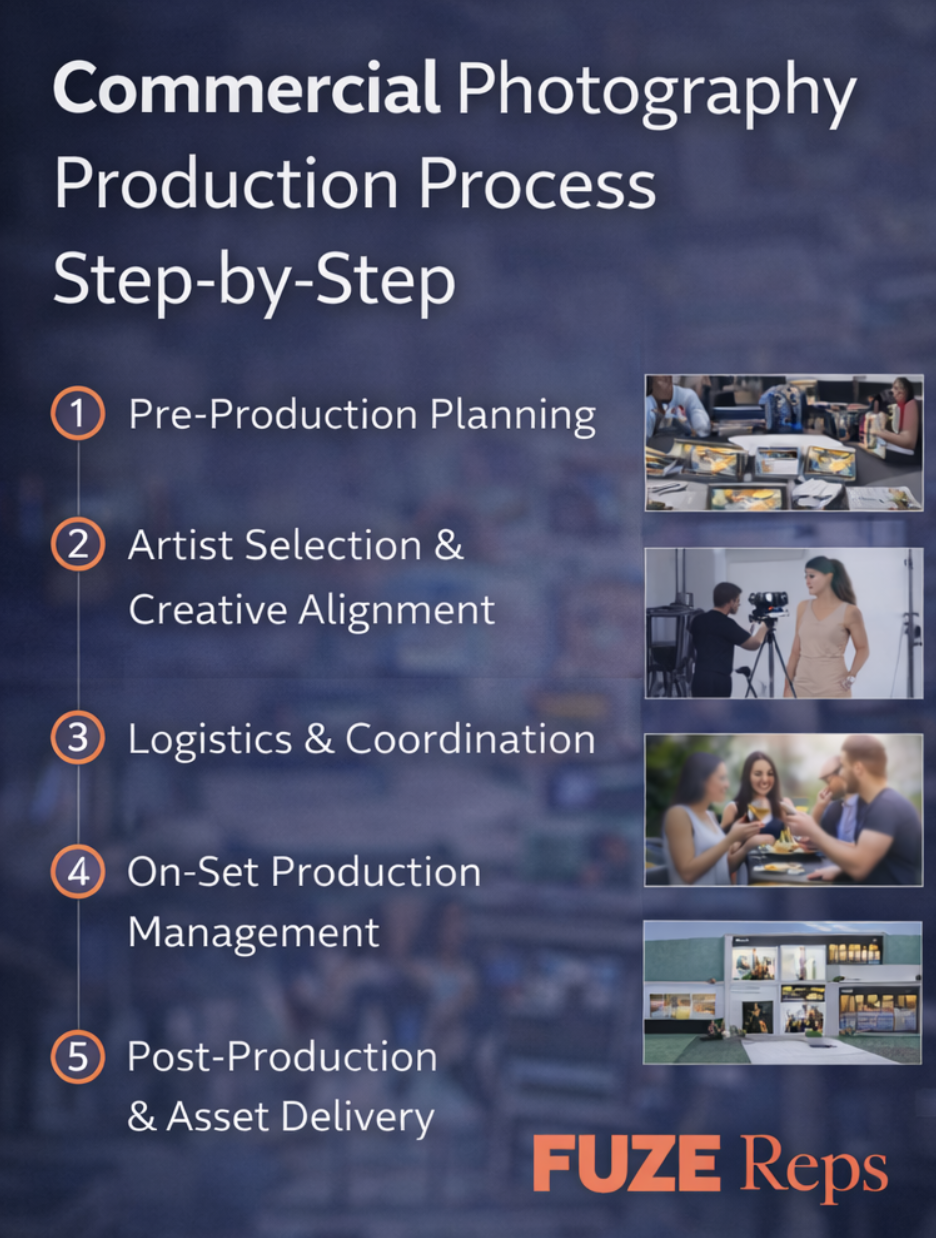
This step-by-step approach ensures that every detail is considered, from the initial creative brief to the final delivery of assets. At the start of every project, a clear plan is essential for success.
This process is designed to be collaborative and transparent, involving key stages like pre-production planning, artist selection, managing logistics, the shoot itself, and the post-production editing process.
Let's break down each of these steps to understand how professional commercial photography comes to life.
Pre-Production: Briefs, Budgeting, and Scheduling
Pre-production is the critical first step where the foundation for the entire project is laid.
This phase begins with reviewing the creative brief, which outlines the goals, message, and visual style of the shoot.
It's a vital document for aligning the production team with the expectations of commercial clients.
Based on the brief, the next tasks are budgeting and scheduling.
The production team works to create a detailed budget that covers all anticipated costs, from photographer fees and equipment rentals to location and talent expenses.
A realistic timeline is also developed, mapping out key milestones from planning to final delivery.
This initial planning phase is all about setting the project up for success.
By clarifying expectations, defining the scope, and allocating resources effectively, pre-production helps prevent costly surprises down the road and ensures the project stays on track.
Artist Selection and Creative Alignment
Choosing the right photographer is one of the most important decisions in the production process.
A good commercial photographer has more than just technical skill; their artistic style and experience must match the project's creative vision.
The artist selection process involves reviewing portfolios to find a photographer whose kind of work aligns with the brand's aesthetic.
Once a photographer is chosen, the next priority is creative alignment.
The production team facilitates clear communication between the client and the artist, ensuring the photographer fully understands the creative brief, objectives, and brand guidelines.
This alignment is crucial for empowering the photographer to execute the vision effectively.
This step ensures that the creative direction is clearly understood and agreed upon by all parties.
It allows the photographer to focus on their creative work, confident that they are on the right track, while the production team handles the surrounding logistics.
Managing Production Logistics
With the creative direction and team in place, the focus shifts to managing logistics.
This is the behind-the-scenes work that makes a shoot possible.
Production management covers a vast range of tasks, including booking studio time, renting equipment, sourcing props, and coordinating travel and accommodations if needed.
This phase is all about details. The production team ensures that every element required for the shoot is secured and ready to go on the scheduled day.
This proactive management helps mitigate risks and prevents delays, ensuring that client expectations for a smooth process are met.
Effective management of these moving parts is a hallmark of professional commercial work.
It removes the logistical burden from the client and creative team, creating an organized and efficient environment where everyone can perform their roles without worrying about the operational details.
Production support for U.S. brands
Shoot Day Operations and Client Collaboration
The shoot day is when all the planning comes together.
On set, the production management team is in full swing, overseeing the schedule, coordinating the crew, and ensuring everything runs according to plan.
Their goal is to create a seamless and productive environment where the creative vision can be brought to life.
Client collaboration is a key part of this process. Clients or agency representatives are often on set to provide real-time feedback and approvals.
This collaborative workflow ensures that the images being captured meet expectations and are suitable for their intended commercial use.
The production team facilitates this communication, making sure feedback is relayed effectively to the photographer and crew.
By managing the day's operations and fostering a collaborative atmosphere, the production team helps ensure that the shoot is both efficient and creatively successful, leading to a final product that everyone is happy with.
Post-Production: Editing and Asset Delivery
The work isn't over when the cameras are packed away.
Post-production is the final phase where the captured images are refined and prepared for delivery.
This starts with the image selection process, often involving a client proofing gallery where the client can review the best images from the shoot and make their final choices.
Once selections are made, the editing process begins.
This can include retouching to remove blemishes, color correction to ensure brand consistency, and other adjustments to enhance the overall quality of the photos.
This step is crucial for creating a polished and professional final product that meets brand standards.
The last step is asset delivery. The production team prepares the final, high-resolution images in all the required formats and delivers them to the client.
This organized delivery ensures the brand has everything it needs to start using their new visuals across their marketing channels.
Essential Equipment and Technology for Commercial Photography
Creating high-quality commercial images requires more than just a good eye; it demands professional-grade equipment and technology.
From high-resolution cameras and sophisticated lighting to powerful software tools for image editing, the gear used is essential for achieving polished, professional results.
A commercial photographer, whether working independently or as part of a production company, relies on these tools to control every aspect of the image, from camera settings to the final edit.
Let's look at the essential equipment and technology that are standard in the industry.
Cameras, Lighting, and Studio Gear
The foundation of any great photograph starts with the right gear.
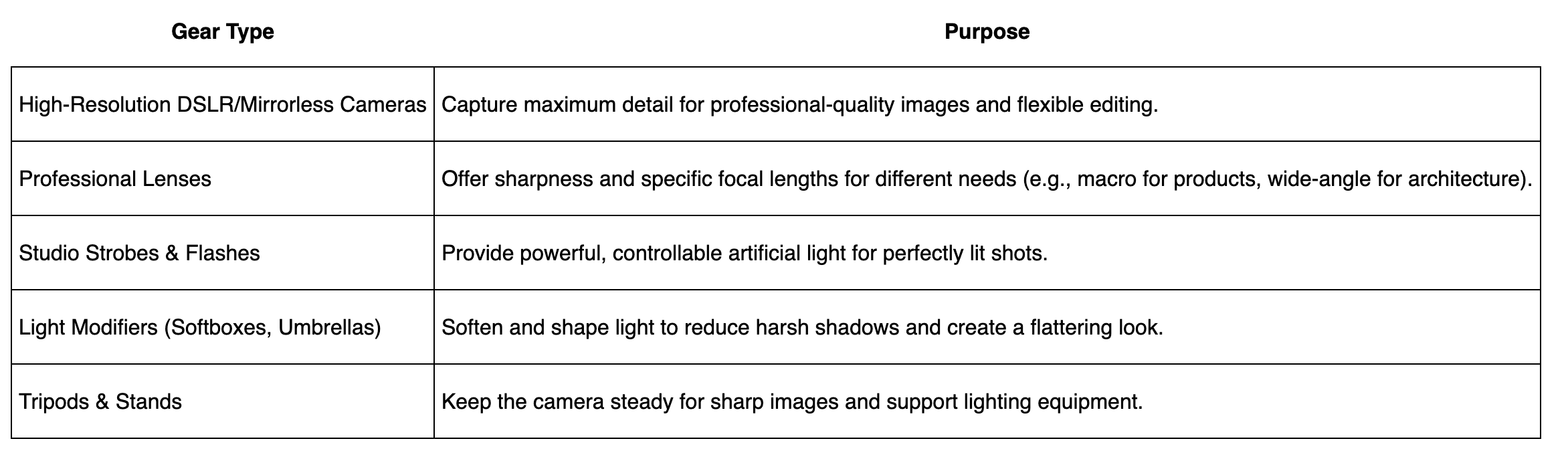
Professional commercial photographers use high-resolution cameras that capture immense detail, providing flexibility for editing and large-format printing.
However, the camera is just one piece of the puzzle.
Lighting is arguably the most critical element. Studio gear like strobes, softboxes, and reflectors allows a photographer to shape and control light to create a specific mood, eliminate harsh shadows, and capture the subject in the best light possible.
Understanding how to manipulate light is a key skill that separates professionals from amateurs.
Having precise control over camera settings and lighting is essential for consistent, high-quality results.
Software Tools for Retouching and Workflow
Capturing the image is only half the journey. The editing process is where a good photo becomes a great one.
Professional photographers and production teams rely on a suite of powerful software tools to refine and perfect the images captured during a shoot.
Programs like Adobe Lightroom and Photoshop are the industry standard for post-production.
Lightroom is used for organizing large batches of photos and making initial adjustments like exposure and color correction.
Photoshop is used for more detailed and complex retouching, such as removing distractions, compositing images, or performing intricate skin or product cleanup.
These software tools give creatives precise control over every pixel, ensuring that the final images are polished, on-brand, and meet the high standards of commercial work.
A skilled retoucher can transform an image, enhancing its impact while maintaining a natural and authentic look.
Digital Asset Management for Brands
Once a shoot is complete, brands are left with a large number of valuable visual assets.
Managing these assets effectively is crucial, and that's where digital asset management (DAM) comes in.
A DAM system is a centralized library for organizing, storing, and distributing all of a brand's media files.
For brands, especially those with extensive online stores or ongoing marketing campaigns, a DAM system is essential for maintaining consistency and efficiency.
It allows teams to easily find the correct version of an image, track usage rights, and share files with internal and external stakeholders.
This prevents the chaos of searching through endless folders and email attachments.
When it comes to asset delivery, production teams can upload final images directly to a client's DAM system.
This streamlines the handover process and ensures that the new photos are immediately available for commercial purposes, ready to be deployed across websites, social media, and other platforms.
Conclusion
In conclusion, understanding the intricacies of commercial photography production is vital for brands and agencies looking to create impactful visual campaigns.
With well-structured processes, from pre-production planning to post-shoot logistics, partnering with a production team can streamline operations while ensuring high-quality outcomes.
This collaboration not only enhances creative alignment but also allows brands to maintain consistency across various projects and markets.
By leveraging the expertise of professionals in the field, businesses can focus on what matters most delivering engaging content that resonates with their audience.
If you're ready to elevate your brand's visual storytelling,
Frequently Asked Questions
What are the advantages of using a commercial photography production studio?
One of the main benefits of commercial photography is the streamlined process a studio provides. They handle all logistics, from casting to location scouting, ensuring your commercial work is efficient. This leads to consistent, high-quality results that enhance your marketing efforts and build brand awareness, while saving you time and stress.
How do commercial photography and video production work together?
Commercial photography and video production often go hand-in-hand to create cohesive advertising campaigns. A marketing department can use both mediums to tell a unified brand story across different platforms. Capturing still commercial images and video content during the same production can be efficient and ensures a consistent visual style.
What should brands look for when choosing a commercial photography partner?
When choosing a partner, commercial clients should start by reviewing their professional online portfolio to see if their style aligns with your brand. A good commercial photographer will have transparent pricing, so be sure to understand the final rate and what it includes. Also, clarify the usage rights for commercial use upfront.